|
Analysis of the Three Dimensions of Solar Street Lamp ClassificationThe classification of solar street lights is diverse, mainly including three dimensions: light source type, application scenarios, and structural form. Under different classification standards, there are various types available. The following details the explanations from these three dimensions.
Classification by Light Source Type The light source of solar street lights directly affects the lighting effect and energy consumption. There are three common types: 1. LED light source: The current mainstream choice, with high luminous efficiency (up to 80lm/W or more), a lifespan of up to 100,000 hours, which is 50 times longer than incandescent lamps and 20 times longer than fluorescent lamps. It starts quickly and has no flicker, suitable for various scenarios. 2. Rare earth energy-saving lamp: Good color rendering, but shorter lifespan (about 5,000 hours), gradually replaced by LED. It is mostly used for small-scale lighting with low color requirements. 3. Xenon lamp: No flicker, with an extremely long lifespan (up to 60,000 hours), suitable for special scenarios requiring stable lighting for a long time (such as industrial parks, warehouses). Classification by Application Scenarios Different scenarios have different requirements for brightness, coverage range, and functional needs. The application scenarios of solar street lights can be divided into four categories: 1. Rural roads: Mainly 6-meter-high single-arm LED street lamps (12V system), meeting basic lighting needs. Low cost and easy installation. 2. Urban roads: Main roads use 10-meter double-arm street lamps combined with lithium batteries (24V system), ensuring wide coverage; secondary roads or residential roadways often use 4-6-meter courtyard lights, balancing practicality and aesthetics. 3. Landscape areas: Such as parks, squares, and green belts in residential areas, commonly use ancient-style courtyard lights or 0.3-1-meter lawn lights/ground-mounted lights, combining decoration and lighting functions. 4. Special scenarios: Remote mountainous areas, islands, etc., without power supply, or places requiring monitoring and broadcasting functions, can use smart solar street lamps integrated with cameras and loudspeakers, supporting real-time monitoring and data transmission.
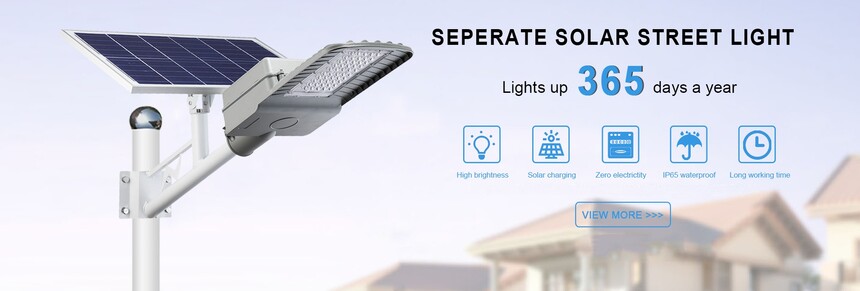
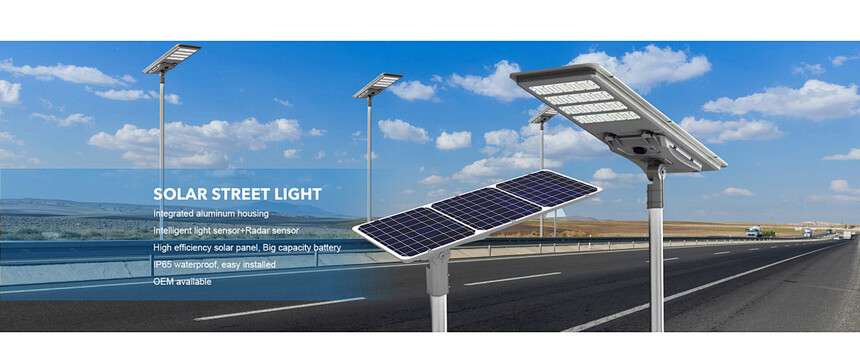
Classification by Structural Form Structural form affects installation, maintenance, and functional expansion. It is mainly divided into three types: 1. Split-type street lamps:Battery panels, lamp heads, and batteries are separated, connected through wires inside the lamp pole. They require a separate battery. Suitable for large roads and highways with high brightness requirements, but installation is complex (requiring assembly and wiring), and maintenance requires checking each component one by one. 2. Integrated street lamps: The light source, battery, and controller are integrated into the lamp head, no need for lamp poles or simplified lamp poles, installation only requires screwing. Mostly used for urban roads, residential areas, and rural roads. Maintenance is done by simply sending it back to the manufacturer, but power and battery capacity are limited, and efficiency is slightly lower. 3.Landscape-shaped street lamps: Such as Chinese lamps, ancient-style lamps, etc., with additional decorative designs on the basic structure, commonly used in scenic areas, historical districts, etc., where an enhanced environmental atmosphere is needed. |